Skip to main content
Contents Index Dark Mode Prev Up Next \(\newcommand{\markedPivot}[1]{\boxed{#1}}
\newcommand{\IR}{\mathbb{R}}
\newcommand{\IC}{\mathbb{C}}
\renewcommand{\P}{\mathcal{P}}
\renewcommand{\Im}{\operatorname{Im}}
\newcommand{\RREF}{\operatorname{RREF}}
\newcommand{\vspan}{\operatorname{span}}
\newcommand{\setList}[1]{\left\{#1\right\}}
\newcommand{\setBuilder}[2]{\left\{#1\,\middle|\,#2\right\}}
\newcommand{\unknown}{\,{\color{gray}?}\,}
\newcommand{\drawtruss}[2][1]{
\begin{tikzpicture}[scale=#1, every node/.style={scale=#1}]
\draw (0,0) node[left,magenta]{C} --
(1,1.71) node[left,magenta]{A} --
(2,0) node[above,magenta]{D} -- cycle;
\draw (2,0) --
(3,1.71) node[right,magenta]{B} --
(1,1.71) -- cycle;
\draw (3,1.71) -- (4,0) node[right,magenta]{E} -- (2,0) -- cycle;
\draw[blue] (0,0) -- (0.25,-0.425) -- (-0.25,-0.425) -- cycle;
\draw[blue] (4,0) -- (4.25,-0.425) -- (3.75,-0.425) -- cycle;
\draw[thick,red,->] (2,0) -- (2,-0.75);
#2
\end{tikzpicture}
}
\newcommand{\trussNormalForces}{
\draw [thick, blue,->] (0,0) -- (0.5,0.5);
\draw [thick, blue,->] (4,0) -- (3.5,0.5);
}
\newcommand{\trussCompletion}{
\trussNormalForces
\draw [thick, magenta,<->] (0.4,0.684) -- (0.6,1.026);
\draw [thick, magenta,<->] (3.4,1.026) -- (3.6,0.684);
\draw [thick, magenta,<->] (1.8,1.71) -- (2.2,1.71);
\draw [thick, magenta,->] (1.6,0.684) -- (1.5,0.855);
\draw [thick, magenta,<-] (1.5,0.855) -- (1.4,1.026);
\draw [thick, magenta,->] (2.4,0.684) -- (2.5,0.855);
\draw [thick, magenta,<-] (2.5,0.855) -- (2.6,1.026);
}
\newcommand{\trussCForces}{
\draw [thick, blue,->] (0,0) -- (0.5,0.5);
\draw [thick, magenta,->] (0,0) -- (0.4,0.684);
\draw [thick, magenta,->] (0,0) -- (0.5,0);
}
\newcommand{\trussStrutVariables}{
\node[above] at (2,1.71) {\(x_1\)};
\node[left] at (0.5,0.866) {\(x_2\)};
\node[left] at (1.5,0.866) {\(x_3\)};
\node[right] at (2.5,0.866) {\(x_4\)};
\node[right] at (3.5,0.866) {\(x_5\)};
\node[below] at (1,0) {\(x_6\)};
\node[below] at (3,0) {\(x_7\)};
}
\newcommand{\N}{\mathbb N}
\newcommand{\Z}{\mathbb Z}
\newcommand{\Q}{\mathbb Q}
\newcommand{\R}{\mathbb R}
\DeclareMathOperator{\arcsec}{arcsec}
\DeclareMathOperator{\arccot}{arccot}
\DeclareMathOperator{\arccsc}{arccsc}
\newcommand{\tuple}[1]{\left\langle#1\right\rangle}
\newcommand{\lt}{<}
\newcommand{\gt}{>}
\newcommand{\amp}{&}
\definecolor{fillinmathshade}{gray}{0.9}
\newcommand{\fillinmath}[1]{\mathchoice{\colorbox{fillinmathshade}{$\displaystyle \phantom{\,#1\,}$}}{\colorbox{fillinmathshade}{$\textstyle \phantom{\,#1\,}$}}{\colorbox{fillinmathshade}{$\scriptstyle \phantom{\,#1\,}$}}{\colorbox{fillinmathshade}{$\scriptscriptstyle\phantom{\,#1\,}$}}}
\)
Section 2.4 Linear Independence (EV4)
Learning Outcomes
Determine if a set of Euclidean vectors is linearly dependent or independent by solving an appropriate vector equation.
Subsection 2.4.1 Warm Up
Activity 2.4.1 .
Consider the vector equation
\begin{equation*}
x_1\left[\begin{array}{c}1\\1\\1\end{array}\right]+x_2\left[\begin{array}{c}2\\0\\-1\end{array}\right]+x_3\left[\begin{array}{c}-1\\2\\0\end{array}\right]=\left[\begin{array}{c}-1\\7\\4\end{array}\right].
\end{equation*}
(a) Decide which of
\(\left[\begin{array}{c}3\\-1\\2\end{array}\right]\) or
\(\left[\begin{array}{c}1\\1\\1\end{array}\right]\) is a solution vector.
(b)
Consider now the following vector equation:
\begin{equation*}
y_1\left[\begin{array}{c}1\\1\\1\end{array}\right]+y_2\left[\begin{array}{c}2\\0\\-1\end{array}\right]+y_3\left[\begin{array}{c}-1\\2\\0\end{array}\right]+y_4\left[\begin{array}{c}-1\\7\\4\end{array}\right]=\vec{0}.
\end{equation*}
How is this vector equation related to the original one?
(c) Use the solution vector you found in part (a) to construct a solution vector to this new equation.
Subsection 2.4.2 Class Activities
Activity 2.4.2 .
Consider the two sets
\begin{equation*}
S=\left\{
\left[\begin{array}{c}2\\3\\1\end{array}\right],
\left[\begin{array}{c}1\\1\\4\end{array}\right]
\right\} \hspace{3em}
T=\left\{
\left[\begin{array}{c}2\\3\\1\end{array}\right],
\left[\begin{array}{c}1\\1\\4\end{array}\right],
\left[\begin{array}{c}-1\\0\\-11\end{array}\right]
\right\}
\end{equation*}
where \(T\) contains a vector missing from \(S\text{.}\) Which of the following is true?
\(\vspan S\) contains a vector missing from \(\vspan T\text{.}\)
\(\vspan T\) contains a vector missing from \(\vspan S\text{.}\)
\(\vspan S\) and \(\vspan T\) contain the same vectors.
Definition 2.4.3 .
We say that a set of vectors is
linearly dependent if one vector in the set belongs to the span of the others. Otherwise, we say the set is
linearly independent .
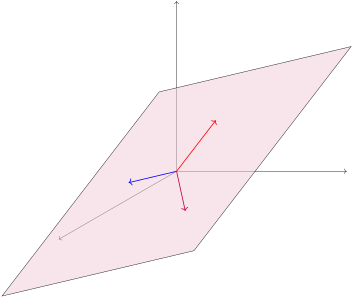
Three vectors in \(\IR^3\text{,}\) no two of which are parallel. They all lie in the same plane, which is shown.
Figure 19. A linearly dependent set of three vectorsYou can think of linearly dependent sets as containing a redundant vector, in the sense that you can drop a vector out without reducing the span of the set. In the above image, all three vectors lay in the same planar subspace, but only two vectors are needed to span the plane, so the set is linearly dependent.
Activity 2.4.5 .
Consider the following three vectors in \(\IR^3\text{:}\)
\begin{equation*}
\vec v_1=\left[\begin{array}{c}-2 \\ 0 \\ 0\end{array}\right],
\vec v_2=\left[\begin{array}{c}1 \\ 3 \\ 0\end{array}\right],
\text{ and }
\vec v_3=\left[\begin{array}{c}-2 \\ 5 \\ 4\end{array}\right]\text{.}
\end{equation*}
(a)
Let \(\vec w = 3\vec v_1 - \vec v_2 - 5 \vec v_3 = \left[\begin{array}{c}\unknown \\ \unknown \\ \unknown\end{array}\right]\text{.}\) The set \(\{\vec v_1,\vec v_2,\vec v_3,\vec w\}\) is...
linearly dependent: at least one vector is a linear combination of others
linearly independent: no vector is a linear combination of others
Solution .
(A).
\(\vec w\) is a linear combination of the others, so the set is dependent.
(b)
Find
\begin{equation*}
\RREF \left[\begin{array}{ccc|c}
\vec v_1 & \vec v_2 & \vec v_3 & \vec w \\
\end{array}\right]=
\RREF \left[\begin{array}{ccc|c}
-2 & 1 &-2 & \unknown \\
0 & 3 & 5 & \unknown \\
0 &0 &4 & \unknown
\end{array}\right]= \unknown .
\end{equation*}
What does this tell you about solution set for the vector equation \(x_1\vec{v}_1+x_2\vec{v}_2+x_3\vec{v}_3 =\vec w\text{?}\)
It is consistent with one solution.
It is consistent with infinitely many solutions.
Solution .
(B). Each variable is set equal to a specific value.
(c)
Find
\begin{equation*}
\RREF \left[\begin{array}{cccc|c}
\vec v_1 & \vec v_2 & \vec v_3 & \vec w & \vec 0\\
\end{array}\right]=
\RREF \left[\begin{array}{cccc|c}
-2 & 1 &-2 & \unknown & 0\\
0 & 3 & 5 & \unknown & 0 \\
0 &0 &4 & \unknown & 0
\end{array}\right]= \unknown .
\end{equation*}
What does this tell you about solution set for the vector equation \(x_1\vec{v}_1+x_2\vec{v}_2+x_3\vec{v}_3 + x_4\vec w=\vec{0}\text{?}\)
It is consistent with one solution.
It is consistent with infinitely many solutions.
Solution .
(C).
\(\vec w\) ’s column is not a pivot, revealing a free variable and infinitely-many solutions.
(d)
It follows that \(\{\vec v_1,\vec v_2,\vec v_3,\vec w\}\) is linearly dependent because \(x_1\vec{v}_1+x_2\vec{v}_2+x_3\vec{v}_3 + x_4\vec w=\vec{0}\) had the number of solutions you found in the previous task. Which feature of which RREF matrix best reveals this?
The
pivot column in the
augmented matrix
\(\RREF \left[\begin{array}{ccc|c}
\vec v_1 & \vec v_2 & \vec v_3 & \vec w
\end{array}\right]\text{.}\)
The
pivot column in the
coefficient matrix
\(\RREF \left[\begin{array}{cccc}
\vec v_1 & \vec v_2 & \vec v_3 & \vec w
\end{array}\right]\text{.}\)
The
non-pivot column in the
augmented matrix
\(\RREF \left[\begin{array}{ccc|c}
\vec v_1 & \vec v_2 & \vec v_3 & \vec w
\end{array}\right]\text{.}\)
The
non-pivot column in the
coefficient matrix
\(\RREF \left[\begin{array}{cccc}
\vec v_1 & \vec v_2 & \vec v_3 & \vec w
\end{array}\right]\text{.}\)
Solution .
(D).
\(\RREF \left[\begin{array}{cccc}
\vec v_1 & \vec v_2 & \vec v_3 & \vec w
\end{array}\right]\) (or
\(\RREF \left[\begin{array}{cccc|c}
\vec v_1 & \vec v_2 & \vec v_3 & \vec w & \vec 0
\end{array}\right]\) ) can be used to solve
\(x_1\vec{v}_1+x_2\vec{v}_2+x_3\vec{v}_3 + x_4\vec w=\vec{0}\text{,}\) and the non-pivot column reveals it has infinitely-many solutions.
Note that (C) technically represents the equation
\(x_1\vec{v}_1+x_2\vec{v}_2+x_3\vec{v}_3 =\vec w\) which isn’t what was asked about.
Fact 2.4.6 .
For any vector space, the set
\(\{\vec v_1,\dots\vec v_n\}\) is linearly dependent if and only if the vector equation
\(x_1\vec v_1+ x_2 \vec v_2+\dots+x_n\vec v_n=\vec{0}\) is consistent with infinitely many solutions.
Likewise, the set of vectors \(\{\vec v_1,\dots\vec v_n\}\) is linearly independent if and only the vector equation
\begin{equation*}
x_1\vec v_1+ x_2 \vec v_2 + \cdots + x_n\vec v_n = \vec{0}
\end{equation*}
has exactly one solution: \(\left[\begin{array}{c}
x_1 \\ \vdots \\ x_n
\end{array}\right]=\left[\begin{array}{c}
0 \\ \vdots \\ 0
\end{array}\right]\text{.}\)
Activity 2.4.7 .
Find
\begin{equation*}
\RREF\left[\begin{array}{ccccc|c}
2&2&3&-1&4&0\\
3&0&13&10&3&0\\
0&0&7&7&0&0\\
-1&3&16&14&1&0
\end{array}\right]
\end{equation*}
and mark the part of the matrix that demonstrates that
\begin{equation*}
S=\left\{
\left[\begin{array}{c}2\\3\\0\\-1\end{array}\right],
\left[\begin{array}{c}2\\0\\0\\3\end{array}\right],
\left[\begin{array}{c}3\\13\\7\\16\end{array}\right],
\left[\begin{array}{c}-1\\10\\7\\14\end{array}\right],
\left[\begin{array}{c}4\\3\\0\\1\end{array}\right]
\right\}
\end{equation*}
is linearly dependent (the part that shows its linear system has infinitely many solutions).
Activity 2.4.8 .
(a) Write a statement involving the solutions of a vector equation that’s equivalent to each claim:
(i) “The set of vectors
\(\left\{ \left[\begin{array}{c}
1 \\
-1 \\
0 \\
-1
\end{array}\right] , \left[\begin{array}{c}
5 \\
5 \\
3 \\
1
\end{array}\right] , \left[\begin{array}{c}
9 \\
11 \\
6 \\
2
\end{array}\right] \right\}\) is linearly
independent .”
(ii) “The set of vectors
\(\left\{ \left[\begin{array}{c}
1 \\
-1 \\
0 \\
-1
\end{array}\right] , \left[\begin{array}{c}
5 \\
5 \\
3 \\
1
\end{array}\right] , \left[\begin{array}{c}
9 \\
11 \\
6 \\
2
\end{array}\right] \right\}\) is linearly
dependent .”
(b) Explain how to determine which of these statements is true.
Activity 2.4.10 .
What is the largest number of
\(\IR^4\) vectors that can form a linearly independent set?
You can have infinitely many vectors and still be linearly independent.
Activity 2.4.11 .
Is it possible for the set of Euclidean vectors \(\{\vec v_1, \vec v_2,\ldots, \vec v_n, \vec 0\}\) to be linearly independent?
Subsection 2.4.3 Individual Practice
Activity 2.4.13 .
Consider the statement: The set of vectors
\(\left\{\vec{v}_1,\vec{v}_2,\vec{v}_3\right\}\) is linearly dependent because the vector
\(\vec{v}_3\) is a linear combination of
\(\vec{v_1}\) and
\(\vec{v}_2\text{.}\) Construct an analogous statement involving ingredients, meals, and recipes, using the terms
linearly (in)dependent and
linear combination .
Activity 2.4.14 .
The following exercises are designed to help develop your geometric intuition around linear dependence.
(a)
Draw sketches that depict the following:
Three linearly independent vectors in
\(\IR^3\text{.}\)
Three linearly dependent vectors in
\(\IR^3\text{.}\)
(b) If you have three linearly dependent vectors, is it necessarily the case that one of the vectors is a multiple of the other?
Subsection 2.4.4 Videos
Figure 20. Video: Linear independence
Subsection 2.4.5 Exercises
Subsection 2.4.6 Mathematical Writing Explorations
Exploration 2.4.15 .
Prove the result of
Observation 2.4.9 , by showing that, given a set
\(S = \{\vec{v}_1,\vec{v}_2,\ldots,\vec{v}_n\}\) of vectors,
\(S\) is linearly independent iff the equation
\(x_1\vec{v}_1 + x_2\vec{v}_2 + \ldots\ + x_n\vec{v}_n = \vec{0}\) is only true when
\(x_1 = x_2 = \cdots = x_n = 0\text{.}\)
Subsection 2.4.7 Sample Problem and Solution